 how-to
How to Verify Authenticity of Pet Supplements
Table of Contents
- Why Pet Supplement Authenticity Matters for Your Dog
- Start With the Label: Reading Ingredient Lists and Claims
- How to Find Third-Party Tested Pet Supplements
- Reading a Pet Supplement Certificate of Analysis
- How to Verify a Pet Supplement Lot Number
- Buying From Authorized Pet Supplement Sellers
- Spotting Counterfeit Packaging and Tamper-Evident Seals
- What to Do When a Product Looks Fake or Mislabeled
- Frequently Asked Questions
Last Updated: October 18, 2026
Why Pet Supplement Authenticity Matters for Your Dog
A counterfeit pet supplement is not a bargain. It is an unknown powder in a familiar bottle, and your dog is the one who absorbs the risk.
At Shop and Bark, we talk to dog owners every day who want a straight answer about what is actually inside the bottle.
Below, we will show you exactly how to run that check in about five minutes, using the same steps we would use ourselves. The payoff is simple.
Start With the Label: Reading Ingredient Lists and Claims
The label is your first filter, and most fake or sloppy products fail here. A legitimate pet supplement lists every active ingredient with a specific amount.
Watch for these red flags:
- Proprietary blends that hide individual ingredient amounts behind one total
- Vague words like "premium blend" or "vet-formulated" with no name attached
- Missing guaranteed analysis, which is the panel stating minimum and maximum nutrient levels
- Health claims that promise cures for disease, which no supplement legally can
- No species listed, since a dog formula and a cat formula are not interchangeable
Ingredient transparency is the whole game.
Also check the directions for use. A real product gives a dosage by weight. A fake often copies generic text that does not match the bottle size or the species.
How to Find Third-Party Tested Pet Supplements
Third-party tested pet supplements are products whose ingredients were checked by a lab that has no financial stake in the result. That independence is the point. An in-house test proves the company trusts itself.
Here is how to confirm the claim is real:
- Look for the testing lab's name, not just a badge graphic.
- Search the lab's website for the product or brand.
- Ask the seller for the certificate of analysis (COA) for your specific batch.
- Confirm the COA matches the product name, lot number, and date.
A badge with no lab name behind it is decoration. A named lab with a findable record is evidence.
The FDA's guidance on animal food and supplement ingredients is a useful reference for what manufacturers are expected to document, and it helps you ask better questions of any seller.
Reading a Pet Supplement Certificate of Analysis
A pet supplement certificate of analysis is a lab report that states what was tested, the method used, and the result for a specific batch. It is the closest thing to proof you will get without sending the bottle to a lab yourself.
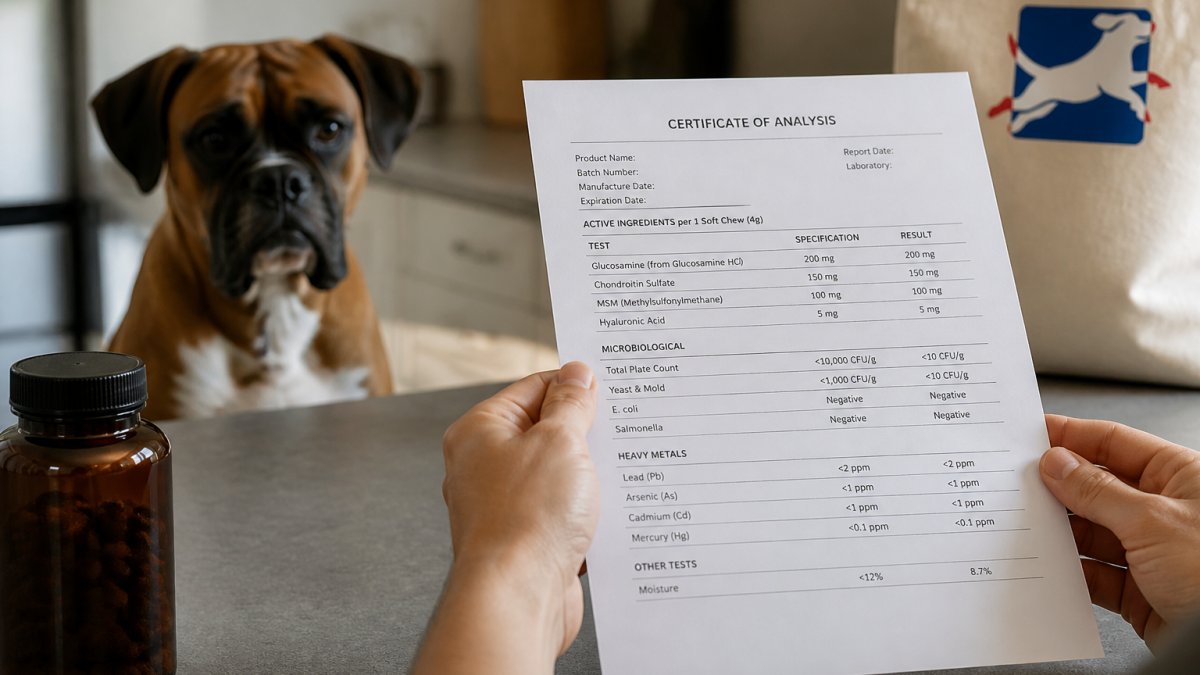
Step 1: Match the document to your bottle
Read the COA in this order, and stop at the first mismatch:
- Product name and form must match your bottle exactly, a powder COA does not cover a chew
- Lot or batch number must match the code printed on your packaging, character for character
- Manufacture or expiration date should fall within a realistic window for the product type
- Test date should be recent enough to reflect the batch you hold, not a report from years ago
A COA that lists no lot number, or lists a lot number that does not match your bottle, cannot verify your product. That is the single most common failure point.
Step 2: Confirm the lab is real and independent
A COA is only evidence if a real, independent laboratory issued it. Check these details:
- Named laboratory, the report should carry the lab's full legal name, address, and contact information, not just a logo
- Accreditation, look for an accreditation body and certificate number you can search independently; a lab that cannot be found outside the brand's own website is a warning sign
- Independence, the lab should not be owned by, or exclusive to, the supplement brand
- Verifiable report ID, many labs let you enter a report number on their own site to confirm the document is genuine
If the only place the COA exists is a PDF on the seller's product page, treat it as a marketing asset until you can confirm it with the lab.
Step 3: Read the test scope, not just the pass/fail
A COA tells you what was tested and what was not. Look for:
- Identity testing, confirms the ingredient is what the label says
- Potency or assay, shows the active ingredient is present at the stated amount
- Contaminants panel, heavy metals, microbials, and, where relevant, pesticide or solvent residues
- Detection limits, a result reported as "not detected" means little if the limit of detection is high
A COA that tests only for identity does not prove potency. A COA that tests only potency does not prove purity. Read the analyte list before you trust the summary line.
Step 4: Know what a COA cannot tell you
Testing has limits, and honest labs state them. A COA covers the sample submitted, not every bottle in the run. It does not prove the product is effective, and it does not prove the product is safe for every dog. It is strong evidence about one batch, not a guarantee about the brand.
If a seller cannot or will not produce a batch-specific COA from a named, searchable lab, that is your answer. Move on.
How to Verify a Pet Supplement Lot Number
To verify pet supplement lot number details, find the code printed on the bottom or side of the bottle and match it to the seller's or lab's records. The lot number, sometimes called a batch number, ties your specific bottle to a specific production run.
Run this check:
- Locate the lot code and expiration date on the packaging
- Confirm the code is printed clearly, not a sticker slapped over another code
- Ask the seller for the COA that lists this exact lot
- Check that the expiration date is realistic for the product type
- Save a photo of the code in case you need to report a problem
A seller who cannot produce a batch-specific document is telling you something. Believe them.
Buying From Authorized Pet Supplement Sellers
Authorized pet supplement sellers are retailers the brand has approved to stock its products. Buying from one removes a whole category of risk, because the supply chain from maker to shelf is known and the brand stands behind the sale.
Verify the seller, not just the listing
Before you buy anywhere, run these checks:
- Brand's own store locator, most brands publish an authorized-retailer list; if the seller is not on it, ask why
- Seller identity, the listing should show a real business name and address, not a string of random characters
- Manufacturer information, the label and listing should name the manufacturer, not just a distributor
- Return policy, a clear, findable return policy is a sign of an accountable seller
- Contact channel, a phone number or support email you can actually reach before purchase
Marketplace and supply-chain checks
Large online marketplaces host both authorized sellers and resellers moving diverted, expired, or repackaged stock. The product page can look identical in both cases. Check the seller behind the listing:
- Who is the seller of record? The name shown at checkout, not the brand name in the title
- Is the seller listed by the brand as authorized? If not, assume added risk
- Is the price suspiciously low? A deep discount on a sealed supplement is a common signal of diverted or near-expiry stock
- Is tamper evidence intact on arrival? A broken inner seal or missing outer packaging is a stop sign
- Does the packaging match the brand's current design? Counterfeiters often copy older artwork
What authorized distribution actually buys you
Buying from an authorized seller does not guarantee a perfect product, but it does give you a known chain of custody, a valid return path, and a seller who can produce batch documentation on request.
At Shop and Bark, we keep our catalog focused on dog products and stand behind what we ship, with orders sent by UPS and USPS. If something arrives damaged or wrong, our customer service team handles it. That accountability is a real part of authenticity.
Spotting Counterfeit Packaging and Tamper-Evident Seals
Counterfeit packaging is often better than people expect, so do not rely on looks alone. Compare the details instead.
Check for these mismatches:
- Seal verification: the inner seal should be intact, centered, and printed consistently
- Packaging differences: font, color, and logo spacing should match the brand's current design
- Product weight: a lighter or heavier bottle than the label states is a warning sign
- English-language labeling: required information should be present and correctly spelled
- Expiration date: should be printed, not rubbed off or missing
Poor print quality, typos, and a seal that peels off in one clean sheet are classic tells. So is a bottle that arrives with no outer packaging when the brand normally ships one.
What to Do When a Product Looks Fake or Mislabeled
If a product looks wrong, stop giving it to your dog. That is the first and most important step.
Then take these actions:
- Photograph the bottle, lot number, seal, and receipt.
- Contact the seller and request a refund and a batch-specific COA.
- Report the product to the manufacturer using the contact on their official site.
- Report suspected fakes to the FDA's MedWatch reporting program.
- File a complaint with your state attorney general's consumer protection office.
Watch your dog for changes in appetite, energy, or digestion after any new supplement, and call your vet if something seems off.
Frequently Asked Questions
How do you know which pet supplements are legitimate?
Start with the label and work outward. A legitimate pet supplement lists every active ingredient with a specific amount, names the manufacturer or distributor, and carries a lot number and expiration date. Look for a third-party testing claim you can verify through a certificate of analysis. Then confirm the seller is an authorized retailer rather than an unknown marketplace storefront. If any of those pieces is missing or the seller cannot produce testing documentation when asked, treat the product as unverified.
What should a certificate of analysis for a pet supplement include?
A useful certificate of analysis for a pet supplement should identify the product and the specific lot number tested, name the independent laboratory that ran the tests, and list the results for identity, purity, potency, and contaminant screening. It should show the test date and a method reference for each assay. A document that only lists ingredient names with no lot number or lab name tells you very little. Ask the seller for the certificate that matches the lot on your bottle, not a generic sample.
Can you check a pet supplement's lot number with the manufacturer?
Yes. Find the lot number, usually stamped on the bottom or side of the bottle near the expiration date. Contact the manufacturer through the phone number or website listed on the label and ask them to confirm the lot exists, when it was produced, and whether a certificate of analysis is on file for it. A manufacturer that cannot match the lot to a production record is a warning sign. Keep a photo of the lot number in case you need to follow up.
Does the FDA approve pet supplements before they are sold?
No. The FDA does not approve pet supplements before they reach the market. Unlike drugs, supplements are not reviewed for safety and effectiveness before sale, and companies are responsible for making sure their products meet labeling and manufacturing requirements. That is why third-party testing, certificates of analysis, and seller verification carry so much weight. You are doing the checking that the pre-market review process does not do for you.