 blog
Best Dog Playpens for Indoor Use: Top Picks & Setup Guide
Table of Contents
- Types of Dog Playpens for Indoor Use
- How to Choose the Right Size and Height
- Safety Features and Escape-Artist Prevention
- Indoor Dog Playpen with Floor Mat: Protecting Your Floors
- Puppy Playpen Setup Tips for Your Home
- How Long Can a Puppy Stay in a Playpen?
- Conclusion
- Frequently Asked Questions
Last Updated: September 13, 2026
Types of Dog Playpens for Indoor Use
The best dog playpens for indoor use balance containment with comfort; material shapes durability, cleaning, and fit.
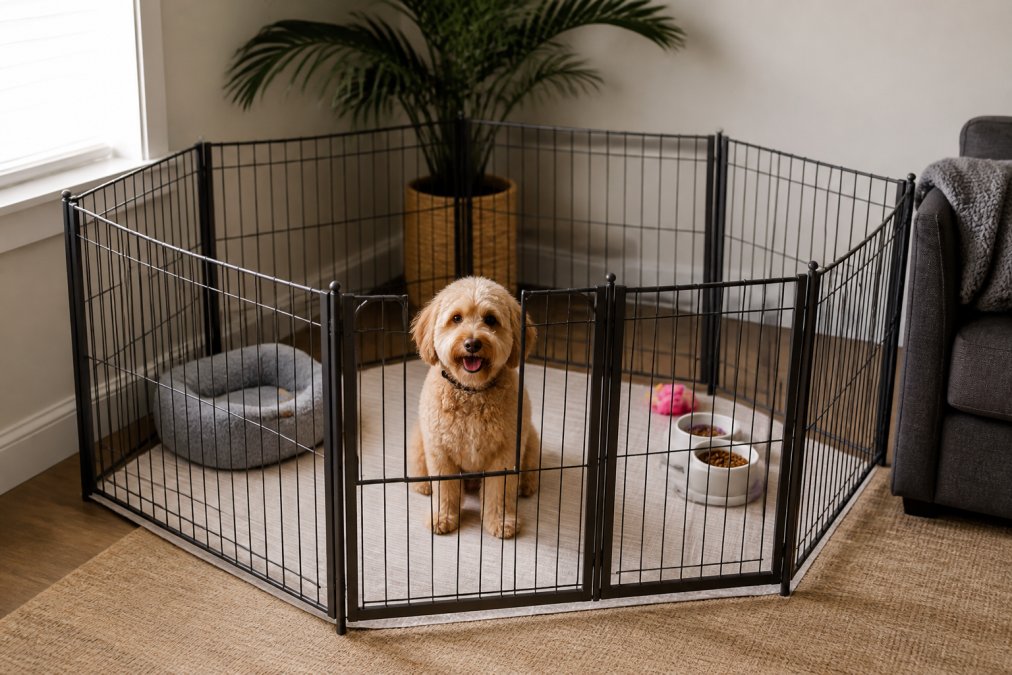
A dog playpen is a freestanding enclosure that gives a puppy or small dog a safe, contained area indoors without a built-in gate or a crate. Most indoor pens fall into three material categories.
Fabric vs. Metal vs. Plastic
Fabric pens are the lightest and most portable, often with mesh ventilation panels that fold flat, but a determined chewer can work through soft material.
Metal pens use heavy-duty, rust-resistant construction and most assemble tool-free into modular panels. They withstand jumping and scratching far better than fabric, making them the common pick for puppy house training.
Plastic pens sit between the two: easy to wipe clean and gentle on floors, but with less height and stability against a dog that leans hard on the walls.
| Material | Best For | Key Strength | Main Drawback |
|---|---|---|---|
| Fabric | Travel and quick setup | Lightweight, folds flat | Chew-prone |
| Metal | Puppy training | Sturdy, modular | Heavier to move |
| Plastic | Easy cleaning | Wipes clean, floor-friendly | Lower stability |
How to Choose the Right Size and Height
Size and height are where most buyers get it wrong, usually too small. A pen that fits a young puppy becomes cramped within weeks.
Measure your dog's adult height at the shoulder, then add a buffer for jumping. For most small and medium breeds, 24 to 30 inches keeps a motivated dog inside; for larger or athletic breeds, look for 36 inches or more (Crate Sizing for Dogs: How To Pick the Right One).
Floor space matters just as much. Give your dog room to stand, turn around, stretch out, and take a few steps, more than crate standards, since the pen is where your dog spends awake time with toys and water.
- Puppies under 10 pounds: a pen around 24 inches tall with at least 8 square feet of floor space
- Small breeds up to 25 pounds: 24 to 30 inches tall, 10 to 12 square feet
- Medium breeds: 30 to 36 inches tall, 12 square feet or more
- Escape-prone dogs: add 6 inches of height clearance above your estimate
Check the manufacturer's weight and height guidance, and size up rather than down when between options.
Safety Features and Escape-Artist Prevention
Escape prevention comes down to three things: latch quality, panel stability, and height. Dogs who escape are solving a specific problem, height, leverage, or a weak point, and the fix depends on which.
Diagnose the Escape Type First
Before buying or modifying a pen, figure out how your dog gets out. The countermeasure is different for each:
- The climber goes over the top. Fix: add height, add a top panel or cover, or remove launch points.
- The jumper clears the wall from a standstill. Fix: more height than you think you need, plus a pen that doesn't flex when they land against it.
- The pusher leans until panels shift or the base slides. Fix: anchoring, non-slip feet, and a pen with locking panel joints rather than friction-fit ones.
- The chewer works at mesh, zip ties, or soft joints. Fix: metal construction, no exposed plastic connectors within reach, and no fabric panels.
- The digger works at the base. Fix: a floor-level panel or a mat the pen sits on top of, so there's no gap to exploit.
Height: The Margin That Actually Works
The most common escape mistake is buying a pen exactly at your dog's jump height. Dogs jump from a standstill with surprising power, so a pen sized to their standing height gives a clear route out. A working rule:
- Measure your dog's height at the shoulder.
- Add the height they can clear from a standstill (often close to their own shoulder height for athletic breeds).
- Add another 4 to 6 inches of margin.
For a dog that has already escaped a pen, add 6 inches above whatever they cleared. If they got over a 30-inch panel, a 36-inch pen is the floor, not the target.
Latch and Joint Security
Look for a locking mechanism a paw or nose can't nudge open. The weak points are usually:
- Slide latches that a nose can push from the inside
- Friction-fit panel joints that separate when the dog pushes outward
- Plastic connectors that a chewer can crack or pop
A pen with a positive-locking latch (one that requires a deliberate lift or squeeze to open) and metal-to-metal panel joints is much harder to defeat than one held together by tension alone.
Stability: The Underrated Defense
Surface stability matters more than most buyers expect: a wobbling pen invites climbing, and a dog that feels the wall give will test it harder. Non-slip feet stop the base sliding on hardwood or tile, and anchoring the base, with weights, furniture placement, or a mat, removes tipping risk.
For dogs who've already proven they can get out of things, consider these countermeasures:
- Choose a pen with a top panel or add a cover, since climbers go over, not through
- Weight or anchor the base so the whole structure can't tip
- Avoid placing the pen beside furniture your dog can use as a launch point
- Check that panel gaps are too narrow for a paw or snout to wedge into
- Zip-tie or clip panel joints if the pen uses friction-fit connections
- Remove anything inside the pen the dog can stack or stand on to gain height
When a Playpen Isn't the Right Tool
Some dogs are not playpen candidates, and forcing it creates risk. If your dog has escaped three or more times, injured themselves attempting escape, or shows intense distress (drooling, destructive chewing at the bars, self-injury) when confined, a playpen is the wrong tool. A crate, a gated room, or professional behavioral guidance is safer.
Indoor Dog Playpen with Floor Mat: Protecting Your Floors
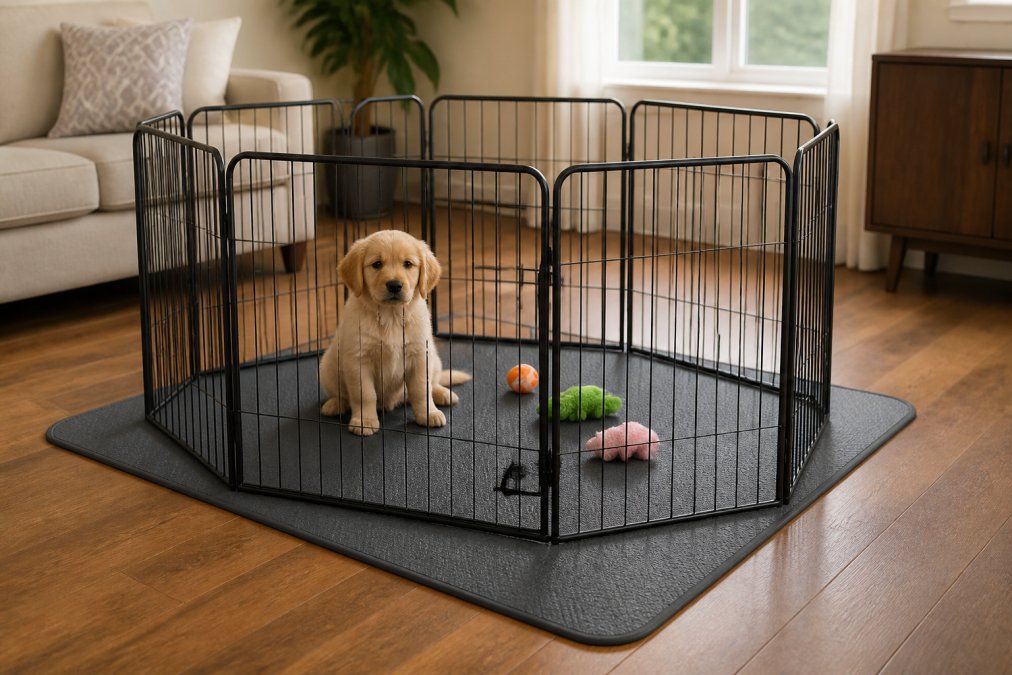
An indoor dog playpen with floor mat solves two problems at once: it protects your flooring and gives your dog a defined, comfortable surface. Hardwood, laminate, and vinyl all scratch, and a puppy's claws plus a sliding pen base reliably leave marks.
What Actually Damages Floors Under a Playpen
Three mechanisms cause most floor damage from playpens:
- Point-load scratching. Metal panel feet concentrate the pen's weight on small contact points. Every time the dog pushes against a wall, those feet grind against the finish. Felt pads or rubber caps on each foot break that contact.
- Sliding abrasion. A pen that creeps across the floor drags grit and claw marks with it. Non-slip backing on the mat stops the creep; a mat without backing just slides with the pen.
- Moisture and urine soak-through. Puppies in house training have accidents. A mat that isn't waterproof lets liquid reach the floor, where it can stain hardwood, swell laminate seams, or seep into tile grout and cause odor.
Matching the Mat to Your Floor Type
| Floor Type | Mat Priority | What to Look For |
|---|---|---|
| Hardwood | Scratch and moisture protection | Waterproof top layer, soft felt or rubber backing, at least 1/4 inch thick |
| Laminate | Seam protection | Fully waterproof, no exposed edges that let liquid run under |
| Tile or stone | Grip and cushioning | Non-slip rubber backing, thicker foam to cushion joints |
| Carpet | Containment and cleanup | Waterproof barrier layer, washable top, non-slip underside |
| Vinyl plank | Scratch and indentation resistance | Firm rubber backing to spread point loads from pen feet |
A washable, waterproof mat is the practical default for puppies. Size it a few inches larger than the pen's footprint on every side, so a shifted panel still lands on the mat, not bare floor.
Layering Strategy That Holds Up
The setup that survives real puppy use is usually two layers, not one:
- Base layer: a waterproof, non-slip mat sized to the full pen footprint plus a 4- to 6-inch border.
- Top layer: a washable pee pad or a second thin mat directly under the dog, so accidents are contained and easy to swap without moving the whole pen.
A few floor-protection strategies that hold up in practice:
- Add felt pads or rubber caps under every metal foot before the pen touches the floor
- Keep the pen off high-traffic areas where it's likely to get bumped and dragged
- For carpet, use a mat with a non-slip backing so the pen doesn't creep
- Check the mat's underside weekly for trapped grit, which is what actually scratches finishes
When You Don't Want a Mat
Some owners skip the mat because they don't like the look. If that's you, the minimum protection is felt pads on every foot plus a waterproof pee pad under the dog's rest and water area. That covers the two highest-risk zones, sliding feet and moisture, without covering the whole floor.
Puppy Playpen Setup Tips for Your Home
Good puppy playpen setup tips start with location. Put the pen where your puppy can see you but can't reach anything dangerous, ideally in a room you spend time in. A puppy isolated in a back room associates the pen with loneliness.
Set up the pen before your puppy arrives home. Let your dog explore it with the door open, toss in a favorite toy, and feed a meal or two inside, so the pen reads as a normal, safe part of the house rather than a cage.
- Place the pen in a climate-controlled spot away from direct sun and drafts
- Remove cords, small objects, and anything chewable from reach
- Add a water bowl that clips to the panel so it can't be tipped
- Rotate toys so the space stays interesting
- Keep the crate inside or beside the pen to support crate training
That last point matters: pairing the pen with a crate gives your puppy a clear distinction between rest and play space, and eases the transition to longer crate sessions.
How Long Can a Puppy Stay in a Playpen?
A puppy should stay in a playpen only as long as its age and bladder can handle, never as a substitute for exercise, attention, or bathroom breaks. The pen is a management tool, not a holding area.
A widely used guideline ties bladder control to age: roughly one hour of holding capacity per month of age (How to Potty Train Your Puppy and Prevent Accidents Indoors). A three-month-old puppy typically manages about three hours between bathroom breaks, the outer limit for a pen session (vcahospitals.com).
For most puppies, keep pen sessions short and frequent:
- Under 3 months: 30 to 60 minutes at a time, with breaks for play and potty
- 3 to 6 months: 1 to 2 hours, depending on the individual dog
- 6 months and up: longer stretches are fine if the dog is exercised and has had a bathroom break
Watch for signs of stress like pacing, whining, or repeated attempts to climb out, those signal the session ran too long. If your puppy shows separation anxiety in the pen, shorten sessions and build up gradually rather than pushing through.
Conclusion
Choosing among the best dog playpens for indoor use comes down to matching material, size, and safety features to your dog and home, then setting it up so it feels like a normal part of daily life. Get those pieces right and the pen becomes one of the most useful tools in your puppy-raising kit.
Shop and Bark is your trusted online source for high-quality dog products, offering everything from apparel and toys to essential health supplies for pet owners seeking convenience and value. With years of industry experience, we've cultivated a fast, user-friendly shopping experience that ensures you can easily find affordable, top-tier items to keep your furry friends happy and healthy. Our customer service-oriented approach means we're always here to help you discover the perfect products, making us the reliable choice for all your pet care needs. Get started with Shop and Bark and give your dog a safe, comfortable space to grow into.
Frequently Asked Questions
Can a dog pen be used indoors?
Yes, dog playpens are designed for indoor use and work well in living rooms, kitchens, or home offices. Look for pens with non-slip feet or a floor mat to protect hard floors, and choose a size that fits your space. Indoor playpens give your puppy a safe area to play while you cook, work, or relax nearby.
Can I leave my dog in a playpen all day?
No. A playpen is a short-term containment solution, not a full-day crate replacement. Puppies need bathroom breaks every one to two hours, plus exercise, meals, and social contact. Use the playpen for 30 to 60 minute stretches while you supervise. For longer absences, pair the playpen with crate training so your dog has a familiar, safe routine.
What is the best indoor dog playpen with a top?
A playpen with a top or mesh cover works best for puppies who climb or jump. Look for a pen with a zippered mesh roof, heavy-duty construction, and a security latch. Tops also keep other pets out and stop toys from flying over the sides. Fabric pens with mesh ventilation and a top are a popular choice for small breeds and puppies.
How do I choose the right size playpen for my dog?
Match the pen to your dog's adult size, not just puppy size. Your dog should stand up, turn around, and lie down comfortably with room for a water bowl and toy. For small breeds, a 24-inch height works. For medium or large dogs, choose 30 to 42 inches. Measure your floor space first, since modular panels let you adjust the layout later.